Jul 27, 2023
Why We Don’t Sell “Soundproof” Curtains or “Noise Reducing” Curtains
The STC rating for most soundproof curtains is in the 20 STC range, maxing out around 26. This is far below the minimum of STC 40. It’s even lower than a double-pane window, which has an STC rating of 28-30.
The Sound Transmission Class (STC) rating system is a scientific rating system that determines how well components of building partitions block sound, like walls, windows, exterior doors, curtains, etc. It’s generally accepted in the sound abatement industry that the minimum rating for soundproofing is STC 40. Anything below 40 does not reduce sound significantly. Soundproof curtains are nearly half the required minimum STC rating of 40.
What Makes for Good Soundproofing?
There are some simple reasons that curtains have a low rating. If you boil down the basic components of effective soundproofing products for windows, you find three main elements are addressed:
1. A tight seal around the opening in the wall where the window is installed.
2. A sufficient air gap between the window and the soundproofing product.
3. Sufficient mass-per-square-foot/meter of the soundproofing product.
Curtains have a sufficient air gap between the fabric and the window’s glass when installed correctly, but they don’t have any seal, nor do they have sufficient mass. Not having any seal means that noise goes around the curtain’s edges. Not having sufficient mass (density) means that sound waves pass through the fabric.
In comparison, soundproof inserts made of laminated glass have all three elements when correctly installed – a tight seal, a sufficient air gap, and high mass (density). That’s why their STC ratings are in the high 40s (ours is STC 48), more than twice the rating of curtains. Even plastic (acrylic) inserts have a much higher rating than curtains, even though their mass is half that of laminated glass.
For a good explanation of the Sound Transmission Class (STC) rating system, please click here. For a more detailed comparison, check out our blog on STC ratings.
Please remember: Any soundproofing product you are considering for your windows needs an STC rating of 40 or higher.
Soundproof Window Inserts: The Better Option
Soundproof window inserts can reduce noise from outside by up to 95%. Curious what it would cost to soundproof your windows? Fill out our online form today and find out what your options are.
Jun 8, 2023
Does foam work as a soundproofing material for windows? The short answer is: no. Plus, you can’t see through it. Even as a temporary measure, it has little or no effect on stopping sound – but it is good at something else. Let’s look at the details so you can avoid wasting your money on foam.
What Makes Soundproofing Material Effective?
One of the fundamental requirements of soundproofing materials is Density, or how much a material weighs. The more dense it is, the more it can absorb and reflect sound. And, conversely, the lighter a material is, the less it can stop sound.
There are many different types of foam, even if you don’t need to see out your window. But foam shouldn’t be on your soundproofing list, because it is very lightweight – the opposite of what you need to stop sound. It doesn’t matter how it is labeled, i.e., Open Cell, Closed Cell, Acoustic, etc., foam, by its nature (lightweight), is not suitable for soundproofing. It is basically air with a bit of glue and coloring. Because it is only a little denser than air, it simply can’t absorb sound.
Video (4:45): What material is the best for soundproofing?
What IS Foam Good For?
People confuse foam panels as soundproofing materials because they are fantastic for sound damping. This is a process used to improve sound quality in a room, such as a recording booth for music or podcasts, so that the resulting audio is clearer and requires less post-processing. The same is true for soundproof curtains. Actual soundproofing does also help with audio quality, but provides a different benefit than sound damping.
What Is The Best Option for Windows?
Laminated glass is well-suited for soundproofing windows. It is very dense, 3.2 pounds per square foot, and clear. Although acrylic plastic is clear, it is only half as dense as laminated glass.
Remember the Density fundamental: The denser/heavier a material is, the more it can absorb and reflect sound. And, conversely, the lighter it is, the less it can stop sound.
If you’re looking for a great soundproofing solution for your windows, fill out or short estimate request form and tell us about your windows. You don’t need to block your windows with foam to block out sound!
Jul 30, 2022
Living in a condo certainly has a lot going for it. From hotel-like amenities to the luxury of letting someone else worry about landscaping and trash removal, there are a lot of advantages. And while these advantages are plenty, living in a condo isn’t perfect; it has a few rather significant trade-offs. Let’s discuss the loudest factor — the noise. We’re going to breakdown everything you need to know about condo soundproofing so that it seems like a less daunting task.
Condos Have Neighbors, Lots of Neighbors
Are condos soundproof? After only a few weeks, condo owners know the answer is a resounding no.
There is bound to be an occasional problem with so many people living close together: having loud neighbors is one example. Even if you get lucky and most of the other owners in your complex are respectful and quiet, you still need to deal with the increased traffic noises and other outside disturbances.
Adding condo soundproofing seems like an ideal response to deal with this excessive noise. However, it can lead you to perhaps the most significant problem with condos: The condo owners’ associations and the boards that run them.
Condos Have Lots of Regulations
Most condo boards are strict regarding what owners can and can’t do with their units. Woe to you if you intentionally or even unintentionally violate these rules. Penalties can be harsh.
Double-check whether your condo has any soundproofing restrictions to prevent unwanted letters from showing up in your mailbox. Read the bylaws carefully and ask the board if there are any updates before starting your soundproofing project. Although it is rare for condos to have regulations about soundproofing interior walls, floors, and ceilings, things can get a bit more complicated when it comes to windows.
Simple Ways of Condo Soundproofing
With the latest rules and regulations in hand, the challenging part comes from figuring out how to soundproof a condo without violating any of them. It can get a bit difficult, but the results make it worthwhile. Starting with the most fool proof way to soundproof – let’s address the windows first.
Condo Soundproofing: Your Windows
Many of our clients express that windows have been one of the most difficult elements of their condo to soundproof, until they call the experts. There are of course different DIY methods that you can use, however many of these methods may be costly and not achieve the desired results. For example, heavy drapes may be a costly solution that will filter light out along with some noise – leaving you with a dark space that is still occasionally noisy.
Brand-new windows is also another solution, but very costly. Not only are new windows costly, but your condo owners’ association’s restrictions and approval-process may be a nightmare. So, what’s a cost-effective, fool proof solution?
An Ideal Solution to Soundproofing Your Condo
Soundproof window inserts from Sun & Sound are a great way to dampen or even eliminate outside noises without replacing your windows or preventing you from using them.
Our soundproof window inserts are made in Texas using quarter-inch lamented glass panels with a Sound Transmission Class rating of 42 when used with single-pane windows and 48 when used with double-pane windows. Studies show that our window inserts reduce up to 75% of low-pitching noises, such as those from highway traffic, and up to 95% of high-pitched noises like squealing breaks and pool pumps.
You won’t need to worry about violating any condo bylaws with soundproof window inserts since they are virtually invisible from the outside. The inserts fit snuggly between the window and your window treatment. You can order our inserts in several sizes, colors, and configurations to match your home’s interior. Tinting is also available.
Once you’ve soundproofed your windows, let’s go over a few remaining items you may want to consider to prevent noise:
Floor Methods to Prevent Noise
Soundproofing a condo doesn’t have to be complicated. As a matter of fact, it can be as easy as buying new rugs.
Adding wall-to-wall carpeting and large area rugs with heavy padding is a great way to prevent noise from below disturbing you, and they also soak up any excessive sounds from your unit. Although just about any carpeting and padding will help, you can find varieties specifically designed to dampen noise for improved results.
Ceiling Methods to Prevent Noise
Rugs and padding are incredible for noise coming from downstairs, but the upstairs neighbors are probably the ones that are really driving you crazy. Unless you are willing to resort to carpeting your ceiling, how can you stop the sounds from above?
Without going through a major remodel involving dropping the ceiling and stuffing the space between the floor joists with insulation, your best option is to install acoustic ceiling tiles. Although acoustic tiles may not be the most aesthetically pleasing option, they are effective and come in various styles to match your décor.
Walls Methods to Prevent Noise
Shared walls let the sound from your next-door neighbors seep into your home and allow your neighbors to hear you. Depending on your condo’s age and construction style, there may be nothing but a couple of sheets of drywall between you and the family next door.
Unfortunately, most condo boards won’t let you punch a hole in the wall to fill the cavity between you and your neighbor with sound-damping insulation. However, there are things you can do. Acoustic paneling is a popular option. Like acoustic tile, it may not be fashionable, but it works. Other possibilities include using sound-damping paint, wallpaper, and fabric wall treatments.
How to Achieve a Quieter Condo – Start with Your Windows
Find relief from noisy neighbors by taking the first step. Give us a call at one of the numbers in the banner, or request a free estimate online. We serve the local metropolitan areas of Austin, Houston, and Dallas.
Nov 6, 2018
Customers often ask how acrylic window inserts (which are plastic) compare to acoustic glass window inserts (which are laminated glass).
Acrylic is Plastic
- Easy to manufacture (cuts easily)
- Lightweight (Reduces shipping costs, but lowers the ability to reduce noise.)
- Easy to scratch
- Discolors over time
“Acoustic-grade Acrylic”
Companies that offer “acoustic-grade acrylic” are actually offering 1/4″ thick acrylic instead of standard 1/8″ thickness. It would be more accurate to call it “double-thickness grade.” Doubling the thickness increases its ability to abate sound because the mass per square foot is increased, not because there are specially engineered characteristics of 1/4″ thick acrylic – it’s just thicker.
Acrylic Glass
Please note that the term “acrylic glass” is a misnomer. Anything made of acrylic is a polymer, not glass. The term “acrylic glass” became popular with marketers when extruders of high-quality acrylic plastic accomplished a clarity (transmissivity) as clear as glass. Acrylic could then be substituted for glass in applications like museum picture frames, displays, signage, etc. However, acrylic is a lightweight material, meaning it absorbs less sound than denser materials like laminated glass.
Laminated Glass
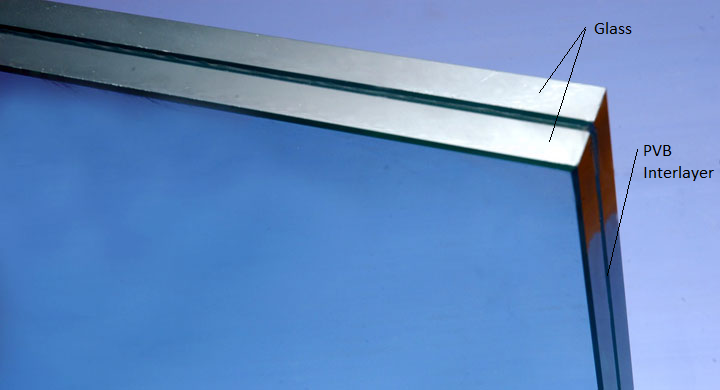
Laminated glass is specially engineered. It’s made of two layers of glass held together by a PVB interlayer, which gives it special acoustical characteristics. The soft PVB interlayer dissipates sound pressure and vibration. Think of the analogy of placing your finger on a ringing bell. The bell stops vibrating and stops making sound. Another characteristic of 1/4″ thick laminated glass is that its mass per square foot is more than twice that of same-thickness acrylic, helping it abate much more sound. It’s also used as safety glass for stores, vehicles, and other places.
If Laminated Glass Is Better, Why Do Companies Offer Acrylic Window Inserts?
Acrylic window inserts are much easier to manufacture, often costs less than laminated glass, and costs less to ship.
We offer acrylic as a lower-cost alternative to laminated glass. Although it doesn’t work as well (we refer to it as “economy grade”), there are many situations where the noise source is mostly upper-mid to upper pitch (frequency), where acrylic can perform well.
How Sun and Sound Windows Compare to Indow Windows
Indow Windows
- DIY focus. You measure and install.
- Compression frame that varies its compressions as the wall shape varies
Sun and Sound Windows:
- Full-service. We do everything.
- Onsite assessment
- Measuring
- Manufacturing
- Installation
- Baffle frame that seals to the surface and causes sound waves to make four 90-degree turns to bypass the frame.
To get a cost estimate for laminated glass soundproof window inserts for your home or office: submit our online form or Contact us.

 281-336-8685