Soundproofing is a team sport. Sound tends to find its way through small holes and tight spaces with ease. Windows, doors, and especially glass doors tend to have a lot of weak points that make them a bit more difficult to soundproof – especially if you still want to use them. Poorly soundproofed glass doors are perhaps the biggest offender in any otherwise soundproofed room.
Why Do Glass Doors Let in Lots of Sound?
First you need to understand the three elements of good soundproofing:
Sufficient Mass
You probably already assumed this one: a door with greater mass is more difficult for sound to pass through. This is because sound is vibration, and a dense, heavy object is more difficult to vibrate.
Tight Seal
The mass of an object doesn’t matter if there’s a hole in it. Sound waves can travel through small holes quite easily. Proper sealing is important for maximum effectiveness.
Air Gap
When sound waves pass through a solid object, then through air, and back through another solid object, they lose a lot of energy. Air gaps reduce energy transmission. This also applies to heat, which means better energy efficiency.
So with that in mind, why do glass doors let a lot of sound pass through?
The glass used in a door typically has much lower mass than a standard wooden door.
Doors inherently have gaps so they can be opened and closed with ease. Glass windows (or entire glass doors) have additional weak points where the glass fits into the frame.
Most glass doors have a single pane of glass, which means they don’t have an air gap.
How to Soundproof a Glass Door
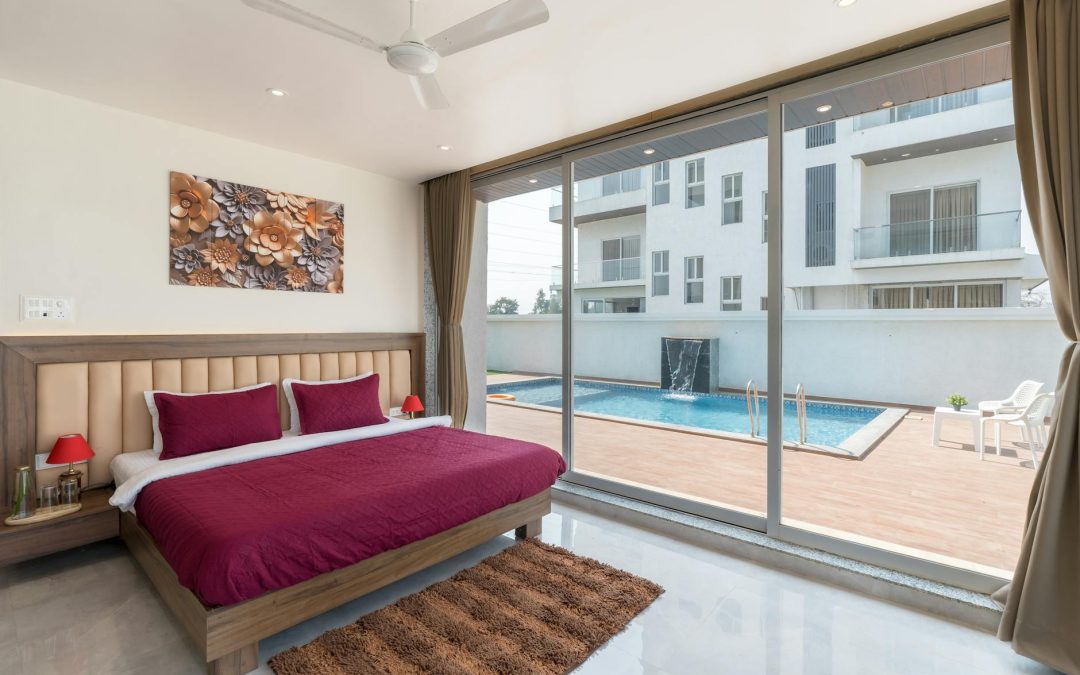
Soundproofing a sliding glass door, a hinged glass door, or any door with a window in it is just like soundproofing a regular window:
You take approximate measurements and submit them for a free estimate
We visit to take more detailed measurements and provide you with a quote
You pay a deposit and we fabricate your inserts
We visit to install the finished product
The inserts for a sliding glass door are like an extra door that fits over the existing one. This door can be operated smoothly and seals tightly to keep the noise out. You can still use your existing window treatments, and the construction to install it is minimal.
How Much Sound Do Soundproof Inserts Block?
Our soundproof doors and window inserts reduce noise by up to 95%. In one of our tests, our soundproof window inserts dropped the decibel reading of nearby traffic from 52 dB to 36 dB.
The noise from some vehicles is difficult to block, such as the low-pitched rumble of an 18-wheeler. Our inserts and doors are excellent at blocking noise from most mid- to high-pitched noises, like cars, squealing train wheels, most music, and people’s voices.
Ready to soundproof your doors? We’re here to help! Proudly local, we serve Houston, Austin, and DFW, and nearby communities. Get in touch today to see what we can do for you.
STC stands for Sound Transmission Class. STC ratings are numbers that describe how well something stops airborne sound from traveling through it. They are used as the standard in the United States for soundproofing materials. Other countries use the SRI, or Sound Reduction Index.
How is STC Rating measured?
STC ratings must be measured by a professional, like an acoustical consultant. The process typically looks like this:
Create a controlled environment with two rooms separated by a wall
Install the product between the rooms
Transmit a range of frequencies through the product
Measure how much of the transmission is lost
This is a scientific process that requires specialized equipment in the hands of a knowledgeable professional. It’s not something that you can DIY if you want your results to be taken seriously.
Is STC Rating Reliable?
Yes – STC ratings for windows, doors, walls, and other materials provide a good comparison of their capability to block sound. Importantly, the number you see on an STC chart may not reflect your actual experience if you install something like an STC rated window yourself.
Remember that the sound transmission class is calculated in a controlled environment by a skilled professional. This means that the installation of the product is perfect – ideal in every way. The actual effect that any given product has on noise may depend on many things, like:
Quality of materials
Quality of installation
How well the rest of the room is sealed or soundproofed
Whether there are alternate paths into the room
The size and shape of the room
The climate, both inside and outside
The frequency of the noise
For more clarity, look at STC ratings as an approximate comparison. Furthermore, hire a professional for the installation of such products – you’ll get much closer to the listed sound transmission class. That’s why at Sun and Sound Windows we make and install our own soundproof window inserts.
STC Rating Chart of Popular Products
The following chart shows average STC ratings for generic barriers (i.e. interior walls) as well as a selection of branded products.
If you’re dissatisfied with your windows and want to block more noise from entering your home, you’re in the right place. Get some rough measurements of your window(s) and fill out our online estimate form – it only takes a few minutes. You’re one step closer to enjoying peace and quiet.
Sound studio soundproofing can be a game changer when it comes to audio quality. Having a totally clean canvas to work with means you have total control of every sound that makes it into your final version. This isn’t the same as sound damping, though, and some products that claim to be soundproof don’t actually do what you think.
Soundproofing vs Sound Damping
Sound proofing is the process of preventing noise from passing into or out of a room. Three properties make soundproofing materials effective:
Mass – more is better. Sound is vibration, and denser materials require more energy to vibrate.
Good sealing. Most sound enters a room through gaps and cracks around windows, doors, walls, and floors.
An air gap. Having space between solid building materials helps dissipate energy as it travels.
Because of this, the materials and installation of soundproofing products make a major difference in the reduction of sound. These products are given an STC rating to describe their soundproofing ability, which is measured by experts in a sound lab.
Sound damping (also referred to as sound dampening or sound deadening) is the process of absorbing sound within a room to prevent it from bouncing around, thereby reducing echoes and increasing sound quality. This has a minor effect on soundproofing, but the main purpose is to improve sound quality.
If you frequently need to remove background noise from audio or video recorded in your studio, soundproofing will improve your workflow. Without the need for heavy editing, your sound quality will also improve, and your recordings will be more consistent.
You may also want to consider studio soundproofing if you have commercial or residential neighbors nearby. Remember – soundproofing is a two-way street. Especially if you’re recording music, and doubly so if you’re recording outside of your local sound ordinance’s quiet hours, this preventative measure will help keep the peace and avoid nuisance complaints.
Soundproofing Windows for Audio Quality
Sound studio soundproofing is only as good as the weakest link. That link tends to be windows. In an otherwise well-sealed room with modern building materials, the windows are likely to have the least mass and smallest air gap which, as you read above, makes for quite poor acoustics.
You don’t need to replace or even cover your window to soundproof it. You can keep the natural light, open and close it as you wish, and avoid major construction by opting for soundproof window inserts. These are sort of like second windows that fit over your existing ones.
Our soundproof window inserts block up to 95% of noise. They are very effective against higher pitch sounds, and can make music nearly inaudible from the other side. See for yourself:
Ready for crystal clear audio?
Request a free estimate online in just a few minutes and get the ball rolling.
Soundproof curtains are marketed as cheap soundproofing for windows. They are thick and heavy curtains designed to absorb sound, and often double as blackout curtains.
Sound proof curtains are similar to sound blankets, and are made of similar materials. They are most often used in recording studios and other rooms where sound quality is important.
Do soundproof curtains block outside noise?
Kind of.
Also called sound deadening curtains or sound dampening curtains, the purpose of these curtains is not to block outside noise, but actually to absorb sound inside the room. They improve sound quality for recordings and performances, just like the foam panels you see on the walls of recording studios.
Do soundproof curtains work? Yes, quite well – for their intended purpose. If you’re looking to reduce echoes in a room and improve sound quality for streaming or recording, acoustic curtains are a great addition.
They do incidentally block a small amount of noise entering the room due to their mass. Any object with enough mass will block some sound.
How much noise do soundproof curtains block?
So, how effective are soundproof curtains? Can curtains block sound from outside?
Typical noise canceling window curtains have an STC rating of around 25. STC rating, or Sound Transmission Class, is a scale used to measure how well a given assembly blocks sound from passing through.
The best soundproof curtains may block quiet voices and slightly muffle certain high pitch sounds. You can consider this a bonus if you were in the market for sound dampening. For soundproofing, however, the STC rating should be 40 or above.
Even though curtains have enough mass to prevent sound waves from passing through, they lack a proper seal, meaning that sound can escape through the sides, top, and bottom.
Soundproof curtain alternative that works
If you’re trying to soundproof a window, don’t use acoustic curtains. With soundproof curtains, you can expect:
Reduced echoes in the room
Minor soundproofing
Loss of light in your room
Changing your decor
Cumbersome cleaning
The best way to soundproof a room with windows is to simply remove the windows entirely. Solid walls can block much more sound than any soundproofing product on the market.
If you want to keep your windows, however, the clear choice is to install soundproof window inserts. These are low-profile glass panels that fit over your existing window.
Our soundproof window inserts:
Have up to 48 STC rating
Block up to 95% of noise
Allow you to still use the window
Let in light
Are barely noticeable
Are quick to install and renter friendly
We are a full-service company, which means we measure, make, and install your inserts to ensure the best possible fit. This isn’t something you want to DIY – the installation is just as important as the insert itself.
Here’s what the process looks like:
Submit our quick online estimate form with approximate measurements. We’ll get back to you within 3 business days with an estimate.
Schedule a day for us to measure your windows. After this, we can provide you with a fixed quote.
We fabricate your inserts, right here in Texas.
We install your inserts. This process is quick and typically takes less than a day to complete.
Get in touch with us today to start reclaiming your peace and quiet!
Noise pollution is a growing problem, and the World Health Organization has issued statements on its dangers. Despite this, there is simply not enough being done to curb noise pollution. Noise harms us slowly over time – so stopping its effects early is worth every effort.
The question isn’t whether we should reduce noise in our homes, offices, and daily lives – it’s how. Soundproofing is an action you can take right now, and will continue to benefit your family for generations, even when legislation finally catches up.
Some of the most common options for soundproofing windows are:
Replacement windows
Soundproof window inserts, also known as acoustic window inserts
Soundproofing curtains
Soundproof curtains don’t work very well; they lack critical elements that are required for sound insulation for windows, and furthermore block light from coming into your home. Many sound resistant windows on the market are also not as effective as their product pages lead you to believe.
We produce soundproof window inserts that can stop up to 95% of the noise entering your home through a window. These are more effective and efficient than most other solutions on the market, especially for the cost.
You may have some misconceptions and questions about soundproof window inserts. Let’s clear those up with some data.
Do Soundproof Window Inserts Work?
The effectiveness of soundproofing material is measured with a Sound Transmission Class rating, or STC rating. Some average STC ratings include:
Soundproof replacement windows: 44 STC
Soundproof interior walls: 41 STC
Exterior walls: 39 STC
Interior walls: 33 STC
Standard double pane windows: 29 STC
Soundproof curtains: 23 STC
Our window inserts have an STC rating of 48, which is well above the minimum of 40 STC required to be considered “soundproofing.”
So what does that mean in practice?
It means reducing the sounds of a busy highway outside your window to the level of a quiet library. Products with this sound transmission class rating can drop readings on a decibel meter from 52 dB to 36 dB in real-world applications.
Are They Expensive?
Purchasing a soundproof replacement window costs around $900 on average. It also requires more labor, is more invasive to the building, and may not be feasible in all situations – like a historic building or a home regulated by an HOA.
Our soundproof window inserts are significantly cheaper than replacement windows, often as little as half the price. They’re much faster to install, and comply with more codes and regulations than replacement windows. The exact price of an acoustic insert depends on the window; enter your information here for an estimate based on your unique situation.
Are Soundproof Window Inserts Durable?
Like all building materials, windows are subject to the elements all day, every day. Wind, rain, snow, and debris can cause scratches, weaken seals over time, and eventually require a window to be replaced. The lifespan of a window varies by its material, environment, and care, but you can expect to replace most windows after 15 to 30 years of use.
Our acoustic window inserts have lasted over 40 years and counting in real situations. They have the benefit of being installed in the interior, meaning they don’t suffer from contact with the elements. They’re also made from laminated glass which is quite durable, doesn’t scratch easily, and can be maintained like a standard window.
What Do They Look Like?
From the outside, acoustic window inserts are totally undetectable – unlike replacement windows, which can completely change a home’s curb appeal. This is especially important for homeowners whose HOA or other regulations require approval for exterior modifications.
On the inside, they’re still barely noticeable. They have a small, paintable frame – less than 1” thick – and don’t require modifications to your existing windows or window treatments. We offer variants that allow you to still operate your window, keeping them functional as well.
Inserts are the ideal solution for most situations in terms of cost, convenience, and efficiency. Whether you’re ready to commit or are just looking for information, get in touch with us for a free estimate today.
Wherever you are trying to work in the world, today’s offices are getting unavoidably noisier and noisier. Soundproofing your home office is a great way to reduce noise and create a more comfortable work environment. Here are some tips for how to soundproof today’s office.
Install Soundproof Windows Inserts to Soundproof Your Office
Installing soundproof window inserts in your home office is one of the best ways to create a quiet and productive workspace. They help insulate against outside noise, providing improved insulation against soundwaves.
When selecting soundproof windows, you should consider their acoustic rating, measured in STC (Sound Transmission Class) values. The higher the STC value, the better it will be at blocking out noise from outside sources. Also, look for insulated frames with weatherstripping and seals that provide additional thermal protection against drafts and further reduce outside noise.
In addition to installing soundproof windows, there are other measures you can take to create a quiet workspace in your home office. Adding carpeting or rugs can help absorb sound waves that may escape through gaps or cracks in your window frames.
Dampen Noise Between Walls
Paired with soundproofed windows, acoustic panels can further reduce background noise between walls in your home, including in your home office. They absorb unwanted sound waves, providing you with a peaceful workspace. These are typically made from materials like foam or fiberglass and can be installed on walls or ceilings to help dampen echoes that may affect your concentration levels while working.
Adding acoustic panels to your home office is a great way to reduce background noise and create a more peaceful work environment. Acoustic panels absorb sound waves, providing a quiet and comfortable workspace. They come in various shapes, sizes, and colors, so it is easy to find one that will match the style of your home office.
When selecting acoustic panels for your home office, consider the level of noise reduction needed. As with your windows, pay attention to each panel’s STC rating. Generally speaking, higher STC ratings are also better for reducing noise levels in small spaces like home offices. In addition to acoustic panels, you can also use wall-mounted absorbers or ceiling clouds for added soundproofing benefits.
Muffle Noise Between Floors
Also paired with soundproofed windows, placing a rug on the floor absorbs sound waves and makes your space quieter. Thick rugs with high piles will work best for this purpose; avoid thinner carpets that don’t fully muffle sound waves.
Generate Noise That Helps You Concentrate
Finally, white noise machines or portable fans can generate soothing background sounds that mask outdoor ambient noises.
Quieter Work Environments Improve Productivity
Creating a quiet and peaceful home office environment is essential for improving productivity. With these simple tips, you’ll be able to create a calmer working atmosphere that helps boost performance while ensuring no challenges due to echo or reverberation in the background!
Soundproof Your Office Best With Window Inserts
Following the steps outlined in this article, you can reduce outside noise levels significantly without breaking your budget, starting with installing window inserts. Quality window inserts will provide superior insulation against soundwaves you need for a work-friendly space, compared to windows alone.
Sun and Sound Windows: Today’s Solution How To Soundproof an Office
Sun and Sound Windows inserts are a great way how to soundproof your home office. Our noise reduction window inserts block up to 75% of low-pitch noise from sources like trucks and A/C compressors and up to 95% of high-pitch noise from brakes, pump machinery, and more. Contact us for a free estimate today!
Sun and Sound Windows uses cookies to improve functionality and to better understand how you use our site, so that we can provide the best possible user experience. By continuing to use our site, you accept our use of cookies and our privacy policy.

 281-336-8685